
I like to plan ahead. If I feel that my campaign is near its end or ran its course, ill speak with my friends at the table; tossing around the idea of a new campaign. We’ve recently been taking a few breaks from our current Advance OSE game, not because I’ve grown tired of the system or the campaign, but because I’ve been captivated by other systems. in between OSE games, I’ve thrown Cyberpunk Red and now more recently, Dark Heresy 2e as one-shots or small adventures of 2-3 sessions.
Now that we have a few systems under our belt: 5e, OSE, Cyberpunk Red, and now Dark Heresy (and any other FFG d100 system for Warhammer) I proposed to vote for our system of choice for our next campaign. Although I wasn’t surprised-yet a bit disappointed- the system chosen was 5e.
Now I have no issues with 5e, kind of, but I am okay with running it but with a few restrictions: PHB+XGE, that’s it. They were okay with this. 5e gets messy when allowing everything under the sun, and honestly boils down to an incoherent mess both mechanically and narratively. But now that was taken care of, I had another issue to solve with 5e, encounters and balance.
Challenge Rating: is it useful or a waste of time?

Even though as Dungeon Masters, the rules are ours to bend and shape; we are the masters of our world and we have the final say, but I do believe some core aspects of the game are important and must serve some function. Often you will see advice from dungeon masters such as “CR is useless”, “CR is incorrect, and should not be trusted” “Pick monsters you think are strong, adjust during combat” which I think is incorrect, misinformed, and the latter robbing the players of their choices or at best, a remedy of an ill choice from the DM.
However, I believe some thought process must have gone into the CR system to be worth being added to the DMG and expanded in XGE. From what I’ve gathered, CR does work; it just takes a bit of math and reading the DMG, of which many 5e DMs do not do and simply dismiss it entirely.
For my case, I am not looking for ‘balance’. Balance would mean I have made a fair challenge suited for the PCs, where PCs have more than a fair shot of leaving the encounter and surviving. Of course this is the general understanding of the community, and for good reason, if the DM is told an encounter is deadly then they should expect so; or worse, if they are told the encounter is easy, they would hope so as well.
However I am looking to challenge my players, and perhaps not all encounters will be as easy as kicking the door and engaging in combat perhaps solved with diplomacy and problem solving with the many abilities and spells the game offers. But I still want to pick monsters within the players range. They might be level 9, but throwing an Ancient Red Dragon seems unfair.
For challenge rating to mean anything, one must follow the medium to hard 5-8 encounters per adventuring day. Now, in a dungeon this is quite easy, more so if you use tools to create dungeons and stock them. However there are some situations where 5-8 encounters in an adventuring day becomes difficult when running a scenario where players are not in a dungeon, yet you still wanna challenge them equally. Forcing 5-8 encounters now becomes a game of “now you fight this, for no particular reason other than to waste resources”. In other games, any encounter could be incredibly challenging, however in 5e, PCs as they level up they accumulate an incredible amount of disposable resources.
In non-dungeon scenarios, if I want less fights but equal challenges my options are: create less encounters, but make them deadlier or tinker with the healing and resting of the PCs. I’ve opted for the latter and honestly no tinkering was done on my part; the DMG offers an alternative, Slow Natural Healing and Gritty Realism for which I’ve decided to choose Slow Natural Healing.
Now onto CR itself. XGE makes the process incredibly easy adding tables such as CR for solo monsters with legendary actions and tables that present the ratio of PC to monster depending on PC’s level and monster CR. For solo monsters even without legendary actions, a group of 4 players can handle a monster 2 or 3 CR above the players average level. As for multiple monsters, I would follow what’s on XGE but a CR calculator also helps, there are a few online. For those encounters I also try to aim to either match the PCs level for the CR of the encounter or above a few. But as a rule of thumb when choosing monsters quickly, PCs can handle either one monster 2 or 3 CR above or a couple of monsters 2 or 3 CR below their current level.
Is Challenge Rating a Good System?
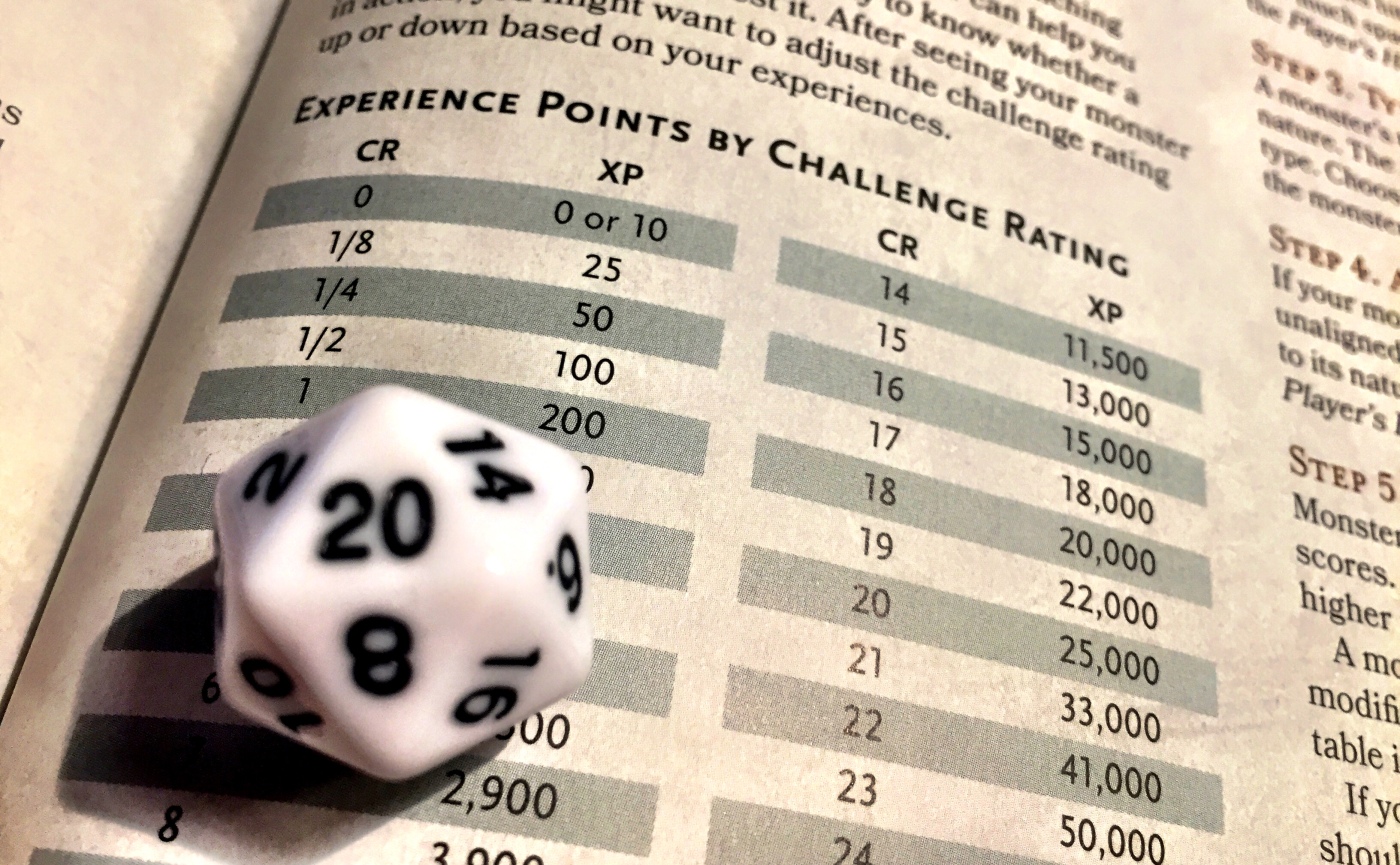
Given the hoops, the math of calculating an encounters CR by hand, the number of encounters per day, and so forth, I would say that CR is not an intuitive system unlike Dark Heresy 2e or Cyberpunk Red where the process is simpler. Cyberpunk Red, telling the GM that each player equals X amount of Mooks or Elites and Dark Heresy, where there is a table telling the GM what would be challenging for a group of X amount of average Exp. Without mentioning the simplicity of older editions of D&D where its recommended that a fair challenge is a monster Hit Dice matching the PC’s level.
Perhaps this is the cost of having a system where the main aspect that is combat, where half of the PHB is related to character abilities mostly about fighting monsters and a good chunk of spells that are also related to combat. If combat is going to be the main feature of a game, balancing and creating a fair challenge becomes more complex. I am yet to read Pathfinder 2e, however I would be interested to know how does creating encounters look in that system.
But still, I do believe the system works for its intended purpose, to give DMs an idea of the monsters strength, and so far with the test encounters I’ve ran with different PCs in different states, such as fully rested, or already down some resources, I can say that CR has been working as it should.

