
The easiest and probably the most entertaining way to prepare an adventure that will contain multiple sessions and hours of fun for the table, is creating your very own dungeon. Dungeons nowadays in the modern edition, are seen as unfashionable, or almost unheard of. I tend to engage with the community and I have heard multiple times, from multiple different people “I’ve never been in a proper dungeon, underground, with traps and puzzles” followed by “Neither have I, now that I think about it” truly something almost surreal to hear from the player base; like playing Cyberpunk Red without any of the cyber enhancements or dystopian cities. The dungeon however, is not the end all solution to all tables, and constant sessions of dungeon crawling can become tiresome, that is why this series of blogs will also add an alternative to dungeon adventures.
Dungeons also lend themselves to be episodic adventures in nature. For some, this could be a bad thing, as players want an over arching plot that will spin continuously until reaching a satisfying end. Just look at Critical Role, a story arc in their games can last anywhere from 15 to 50 episodes, 15 to 50 sessions, 15 to 50 four hour sessions to come to a conclusion. Rather, the dungeon provides the players and the DM a story with a beginning, middle, and end that lets the players continuously build their reputation in game; gives both dm and players a sense of accomplishment and provides variety in locations and stories they can throw themselves into at their choice.
The common notion of the dungeon and why it has fallen out of favor is because players and DMs consider them static, boring, tedious, and perceived as a series of combat encounters with little to no roleplaying or “narrative”. Most of these comments in my opinion, comes from the DMs who do not understand the purpose of a dungeon, as an area of exploration; they do not have the guidelines on how to run a dungeon; its rules now lost in previous editions such as: tracking time within the dungeon and random encounters. Lacking the necessary information to understand why these tools add to the dungeon experience. Dungeneering can still be enjoyable even in 5e, perhaps not in the older sense where the dungeon was actually lethal to PC’s and that was the fun but it can still be a place of intrigue, mystery and exploration along with the tools for the PC’s to still feel heroic and conquer the dungeon with the fantasy empowerment 5e provides.
Prepping for a session, usually takes me a weekend, while doing other stuff in my life. Perhaps the part that takes the most time for me, is the beginning, the concept of the adventure and the themes I want to add. Of course, I am no one to tell you how to come up with an adventure concept, nor can I imagine anything for you. However I can provide you my method of organizing my ideas.
The Name.
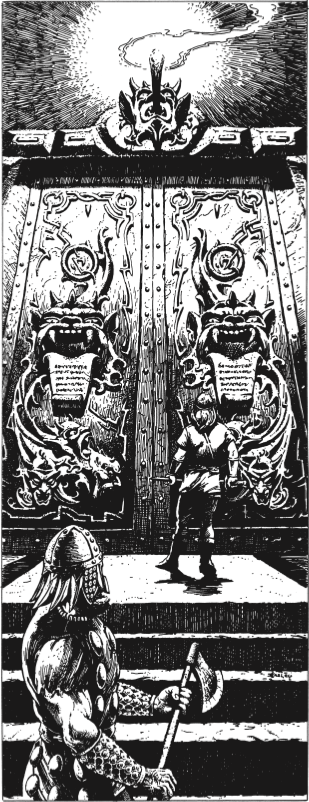
An evocative title to a story can say a lot to the reader, perhaps even a glimpse of what can be behind the book’s cover. Same goes with chapters, a preview of what you will soon read about. I believe that the same can be said about an adventure. Where does your mind go when you hear that you will explore the Tower of the Elephant? Where does your imagination take you if you were told to explore the Tomb of Horrors, The Sinking Keep of the Shattered Sisterhood, The Glimmering Caves of Everska, The Mines of Moria? Having an interesting and almost mythical name to the location your players decided to explore can give you the ideas of how the dungeon looks and what it contains.
Coming up with the name can be simple following this template: “The [adjective] [Location] of [Noun]”. You can stray away of this template and branch off, however this can give you an evocative name for the location you intend to create to explore. From here, using the name, we can begin to piece together what this place can be about and why the locals call the dungeon by that name
The Backstory.
No adventure location is complete without context, perhaps your players won’t question the location they are in and why it exist, but having the reason for it, adds depth to the adventure and adds to the exploration experience of the location. Maybe they will find the reason of its abandonment when none could before? Most dungeons are assumed to be abandoned places: ruins, mines, castles, caves, tombs. This assumption is core to the DNA of the game, this is why you will find out most monsters in the MM of 5e are explicitly designed and evolved to be creatures that excel in dark delves: The Gelatinous Cube, The Carrion Crawler, Trolls, Orcs, Slime. Monsters that live in dungeons make sure to kill whatever isn’t from a dungeon. Why would anyone make their home in a place where there are slime that could dissolve you? With this context now ask yourself, who used to be here originally, what was the original purpose, why aren’t they here anymore, who lives here now, and why won’t common people come to reclaim the ruins and its treasure? You can layer these questions over and over, perhaps the dungeon has had over 3 denizens before the current ones arrived. You don’t need to write a novel about the place, nor do you need all the answers, rather have the context of this location. Down below I will provide you with bullet points questions:
• Who used to live here?
• Why don’t they live here anymore?
• How long has it been?
• Who or what lives here now?
• Why hasn’t the place been explore before?
As an example: Let’s make a name up “The Collapsing Castle of the Scarlet Princess”, now let’s move towards the backstory.
“The Castle was once the property of a noble family who used to rule the surrounding lands, their castle was built upon dwarven ruins which was discovered during construction. Unknown to the noble family as to why the ruins were left abandoned they continued construction of their castle and their dungeon. Soon After uncovering the ruins, the noble family and the settlements around began to grow increasingly ill, with red spots on their skin, irritation and deformation; the first to be struck with the illness was the princess of the noble family. One night, the princess transformed into a hideous red hulking monster, many of the people followed suit with this transformation and the castle was soon abandoned by survivors. Now only chaotic creatures that dwell in the darkness and those of unsavory reputation hide out in the castle ruins, however rumor has it that many of the transformed people and the princess still reside down below; along with the treasure and heirlooms left behind.”
Now we have the context, and from here, we can continue to pool ideas. We have past residents and new ones along with why the place was abandoned and vaguely what to expect.
The Hook.

The hook is what brings your players to the location, the reason of why they are heading out to your dungeon. Of course if playing an old school game, loot should be incentive enough to level up. However a good hook is enough to provide the players with what they can expect in return for following this lead. Personal hooks related to characters are easy, however it doesn’t have to stop there, perhaps the hook can be a promise of political power, the myth of a magical item, a favor to be cashed in the future by an NPC, or just the mystery of an area can be enough for some player. This will engage your players to act and to decide where to go and how to proceed.
In my current campaigns, I provided my players 4 hooks simultaneously: Black dragon sightings to the west in the marshlands attacking caravans, rumor heard by the guards in their home town; The overseer of the town mentioning a tribe of bugbears have been seen around an abandoned fortress reconstructing it and kidnapping the locals to the northwest; a bounty on an evil priest down in the lands of sand and heat who resides in an ivory tower, rumors has it she has a magical item that gives her powers to dominate; and finally, news arrived to the elf player that the elven forest has become hostile, its flora and fauna attacking everyone, and chaotic creatures arise in the woods.
The Objective.
Finally, the objective. What are the players expected to do once they reach the adventure location? It’s important to make this clear to the players what is the goal of the adventure, if not, they will wander aimlessly or more commonly, after they get frustrated, they will start poking you, dungeon master, on what they are supposed to do, either through their characters or out of characters.
The objective should be a verb that is clear and unambiguous: Slay the dragon, find the magic item, bring us the girl and wipe away the debt, travel to Mordor and destroy the ring. These verbs, slay, find, return, destroy; gives the player a clear goal. However even exploration for exploration sake is fun and a clear goal for players.
Now with this information written down on a scrap of paper on your journal or computer, now you have a better idea of what the adventure can be about, or at least on an overview level of what it will be about and we can proceed with Part: 2 of this series, Brainstorming and how we can utilize our ideas and implement them into our adventures.
Introduction
Part 1: The Concept
Part 2: Brainstorming
Part 3: Mapping and Stocking the Dungeon.
 Lair of the Lich